




Envelope Sizes
UK envelope sizes follow the ISO C standard, where each size is designed to hold the equivalent A-series paper. The most widely used formats are DL, C6, C5 and C4, covering everything from business letters and invoices through to A4 documents sent completely flat. Use the table below as a quick reference, then explore each size in detail below.
| Size | Dimensions (mm) | Fits | Common Use |
|---|---|---|---|
| DL | 110 x 220 | A4 folded in thirds | Business letters, invoices, statements |
| C6 | 114 x 162 | A6 flat, A4 folded in quarters | Greeting cards, invitations, personal mail |
| C5 | 162 x 229 | A5 flat, A4 folded in half | Brochures, multi-page documents, invitations |
| C4 | 229 x 324 | A4 flat, no folding | Contracts, certificates, presentations |
| C3 | 324 x 458 | A3 flat | Large prints, drawings, artwork |
| C7 | 81 x 113 | A7, small cards | Gift enclosures, vouchers, seed packets |
| Square 165x165 | 165 x 165 | Square cards | Wedding stationery, event invitations |
| Square 220x220 | 220 x 220 | Larger square cards | Luxury invitations, greetings, artwork |
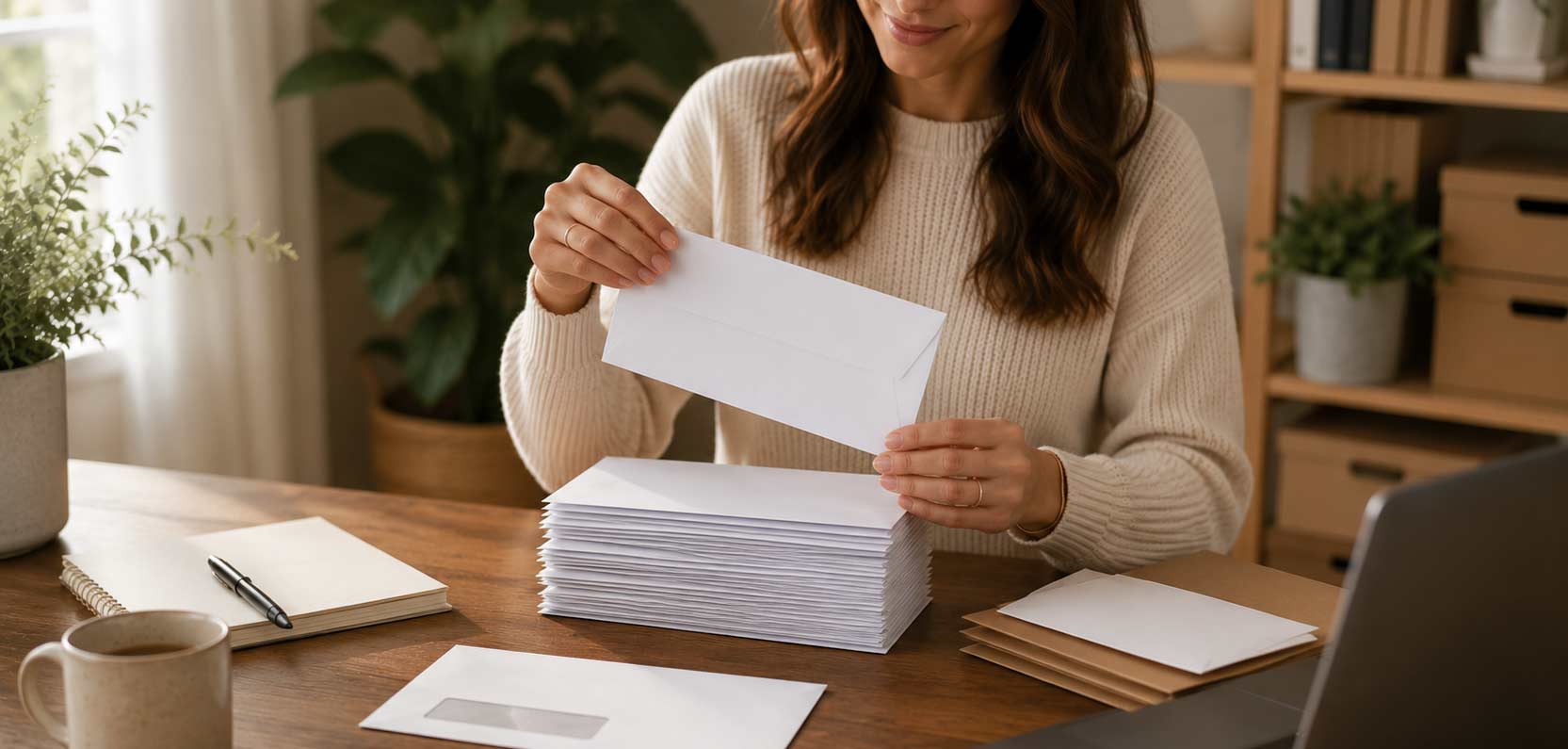
DL Envelopes (110 x 220mm)
Fits: A4 folded in thirds, A5 folded in half
Royal Mail format: Standard Letter, 2nd class from 91p
Typical use: Business letters, invoices, statements, marketing inserts
DL is the most widely used business envelope in the UK. The slim format presents a professional image and keeps postage at the standard letter rate, making it the most cost-effective format for high-volume business correspondence. Available with gummed, peel and seal and self-seal closures, in white, window and a wide range of colours.
DL Envelopes




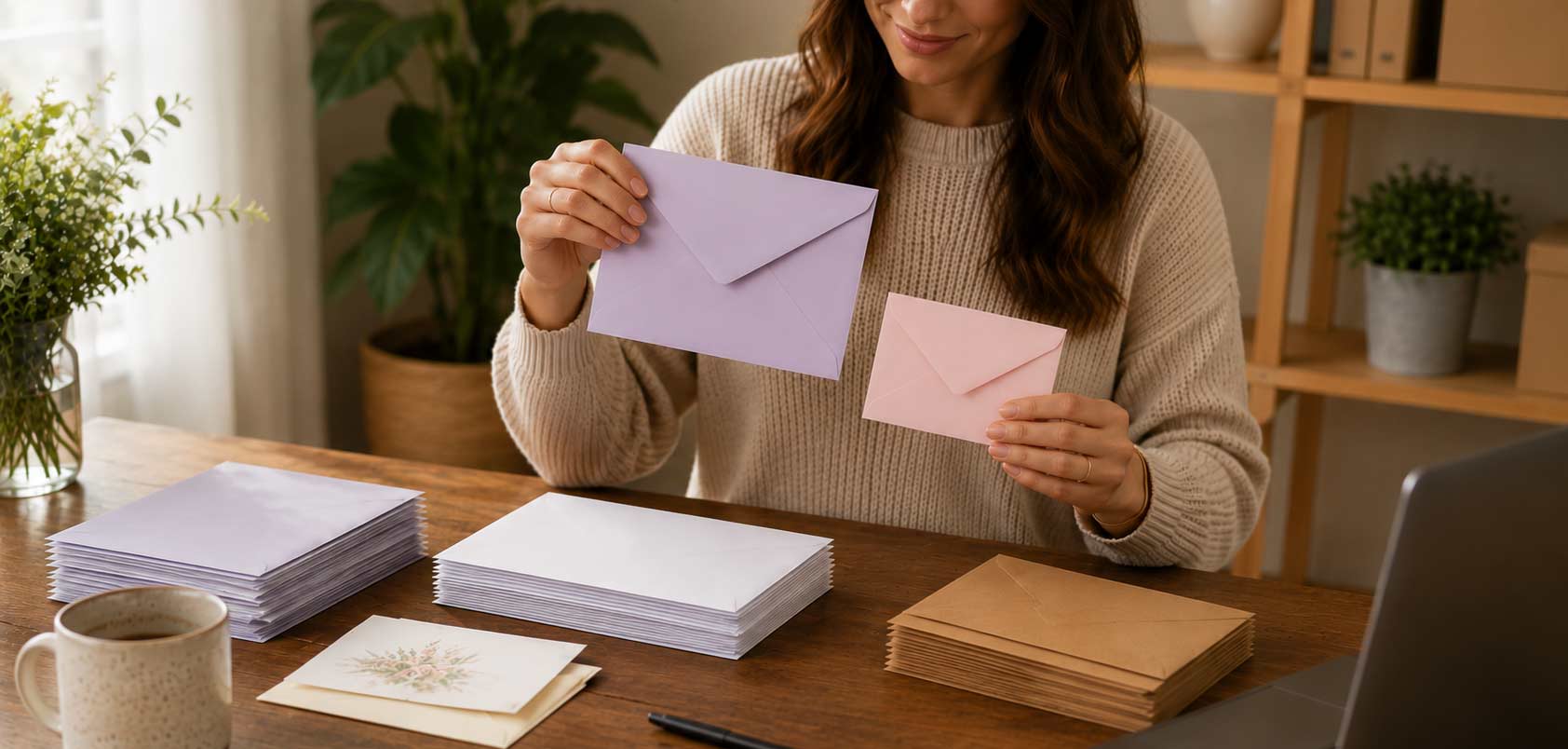
C6 and C5 Envelopes
C6 (114 x 162mm) fits A6 cards flat or A4 folded into quarters. The standard greeting card envelope. Available in an extensive colour range for birthdays, invitations and personal correspondence. Royal Mail Standard Letter rate from 91p.
C5 (162 x 229mm) fits A5 documents flat or A4 folded in half. The practical mid-size choice for brochures, multi-page documents, large invitations and professional correspondence that cannot fit a DL. Royal Mail Standard Letter rate from 91p up to 100g.
Both formats are available in white, manila, coloured and premium finishes with gummed and peel and seal closure options.
C5 and C6 Envelopes


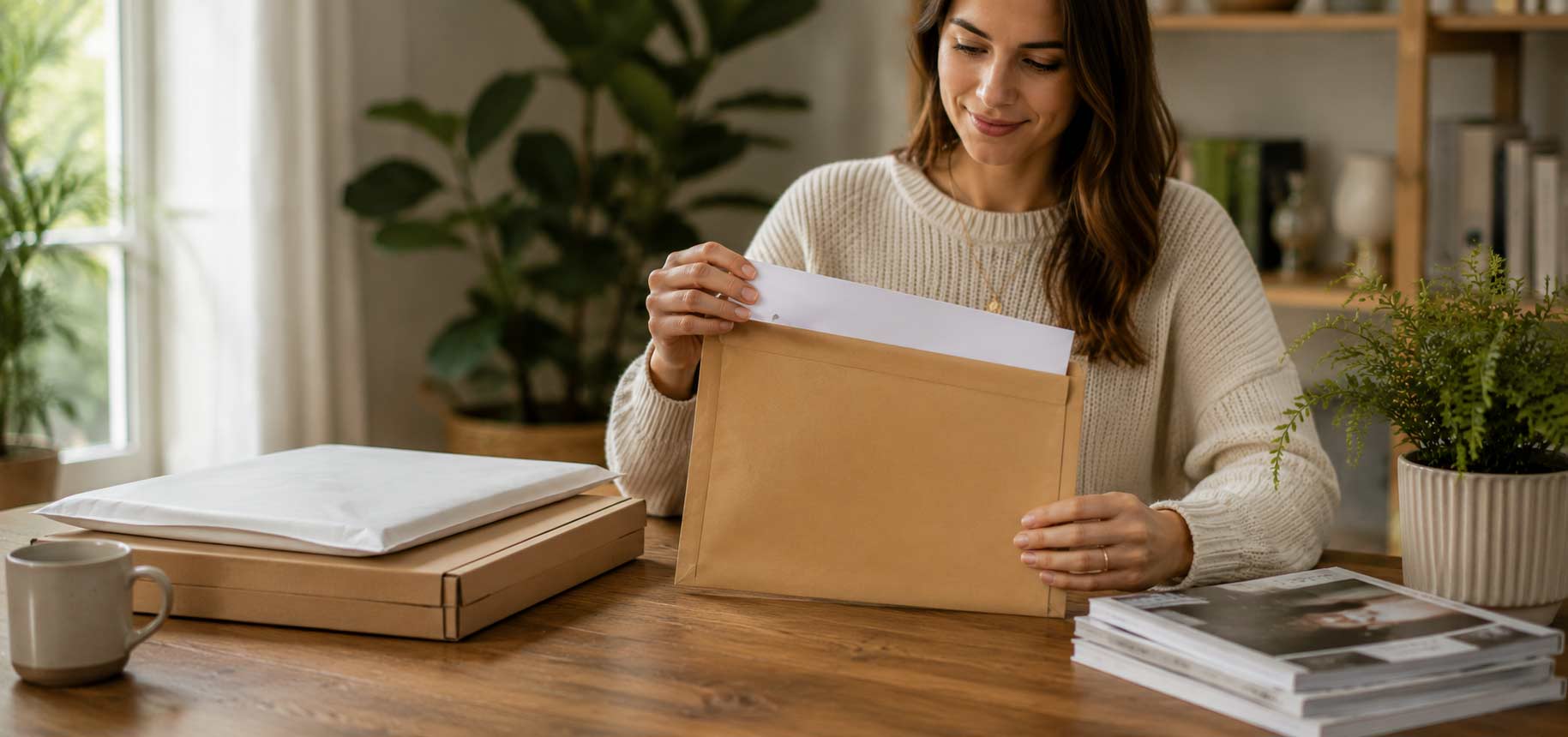
C4 Envelopes (229 x 324mm)
Fits: A4 document completely flat, no folding required
Royal Mail format: Large Letter, 2nd class from £1.55
Typical use: Contracts, certificates, proposals, artwork, board-backed document mailers
C4 is the envelope for documents that cannot be folded. Contracts, legal papers, certificates, professional presentations and architectural drawings all arrive flat and undamaged. Available in standard, board-backed and rigid formats depending on the protection level required. Also available with windows for high-volume document dispatch.
C4 Envelopes


Envelope Styles
Beyond size and closure type, the style of an envelope determines how it opens and how much it can hold.

Wallet
The flap is on the long edge. The most common envelope style for business and personal use. DL and C5 wallets handle the majority of standard correspondence.

The flap is on the short edge. Suited to documents that must arrive flat and unfolded, including contracts, certificates and legal documents sent in C4 pocket envelopes.

Gusset
Expandable side panels allow the envelope to hold bulkier contents, such as catalogues, multi-document packs and product samples that a standard envelope would not close around.

Banker / V-Flap
A diamond or V-shaped flap on the long edge, the classic greeting card and invitation envelope. The characteristic triangular flap is associated with formal stationery and premium correspondence.
Cardboard Boxes
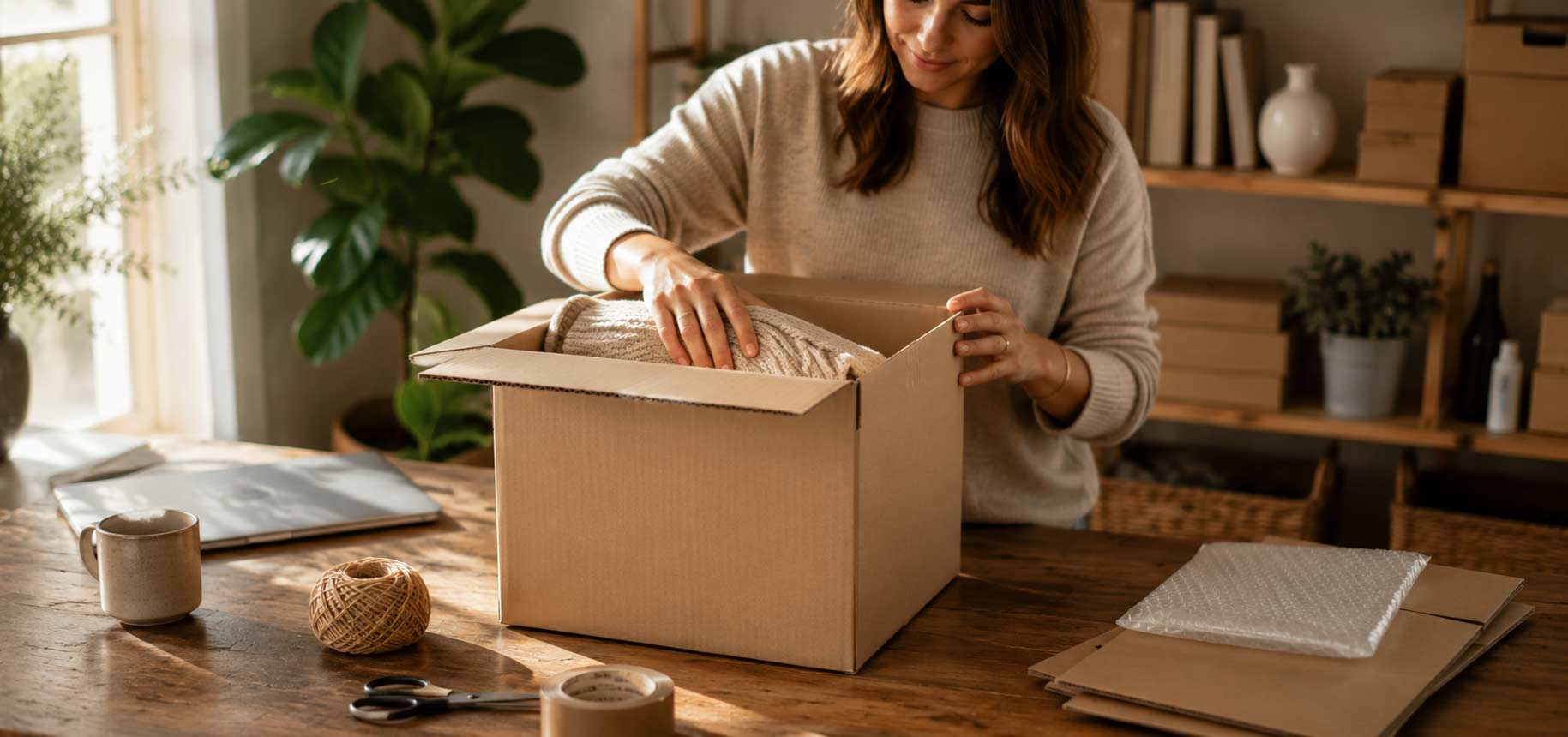
Royal Mail format: Small Parcel (up to 450x350x160mm, 2kg) or Medium Parcel (up to 610x460x460mm, 20kg)
Best for: Fragile items, structured goods, homewares, electronics, multi-item orders
Key rule: Always choose the smallest box that fits the product. Empty space requires void fill and increases both cost and transit movement.
Single wall cardboard boxes handle the majority of standard e-commerce dispatch. Double wall is recommended for heavier or crush-sensitive goods. Large letter postal boxes (max 25mm depth) allow rigid items to qualify for the lower large letter postage rate rather than the small parcel rate.
Cardboard Boxes


Mailing Bags
Packaging Sizes and Formats
For anything beyond a standard envelope, the right packaging format depends on product type, fragility and the postage tier you are targeting. Mailing bags are the lightweight, low-cost option. Cardboard boxes provide rigid, structured protection. Getting this decision right is one of the most reliable ways to reduce per-dispatch postage cost.
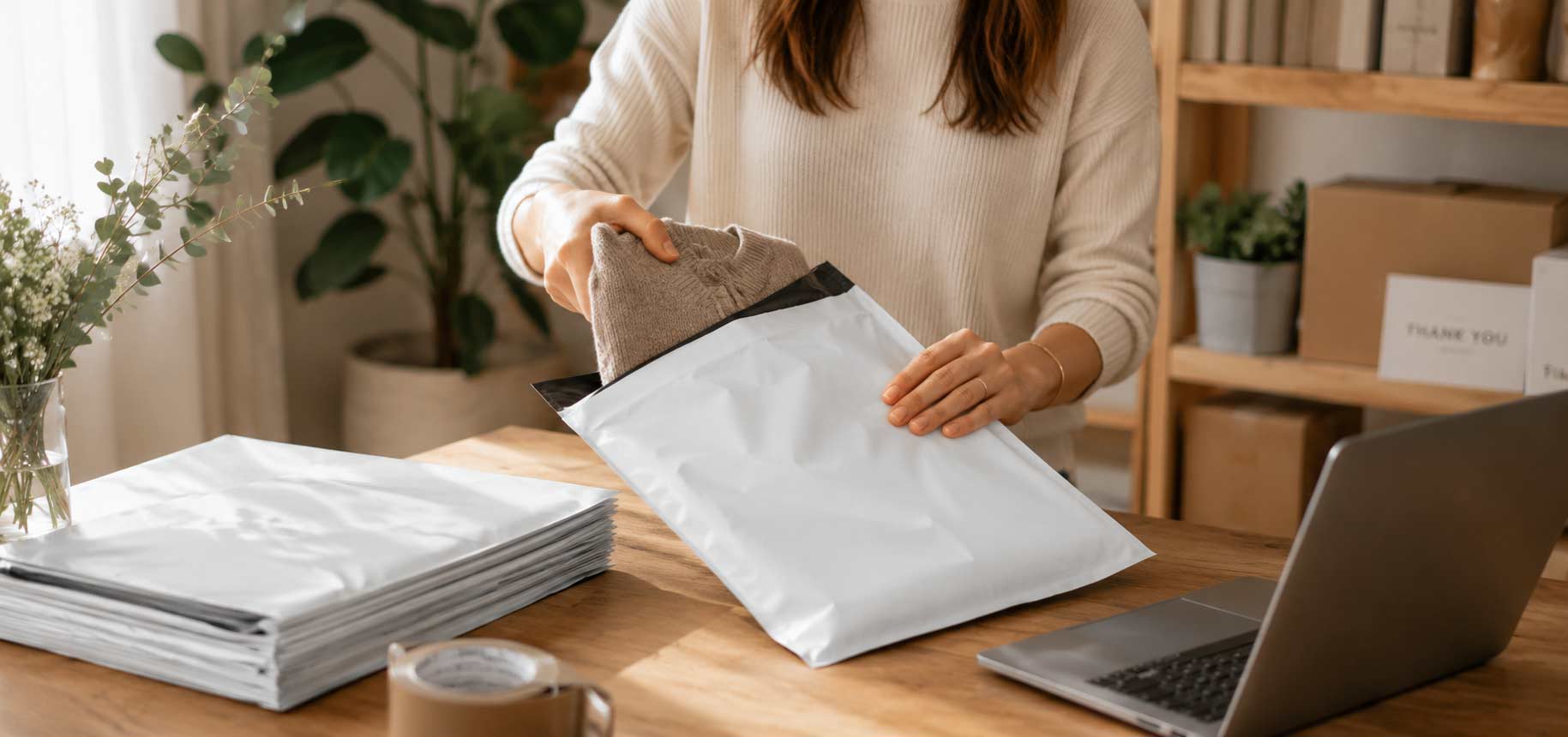
Royal Mail format: Small Parcel, Tracked 48 from £5.65
Best for: Clothing, accessories, soft goods, non-fragile items
Mailing bags are self-seal, waterproof and tear-resistant. Available in plain white and grey, coloured and metallic formats for premium presentation, and eco-friendly recycled options. Padded bubble bag variants provide cushioning for fragile items within the same lightweight format.
Mailing Bags


Labels
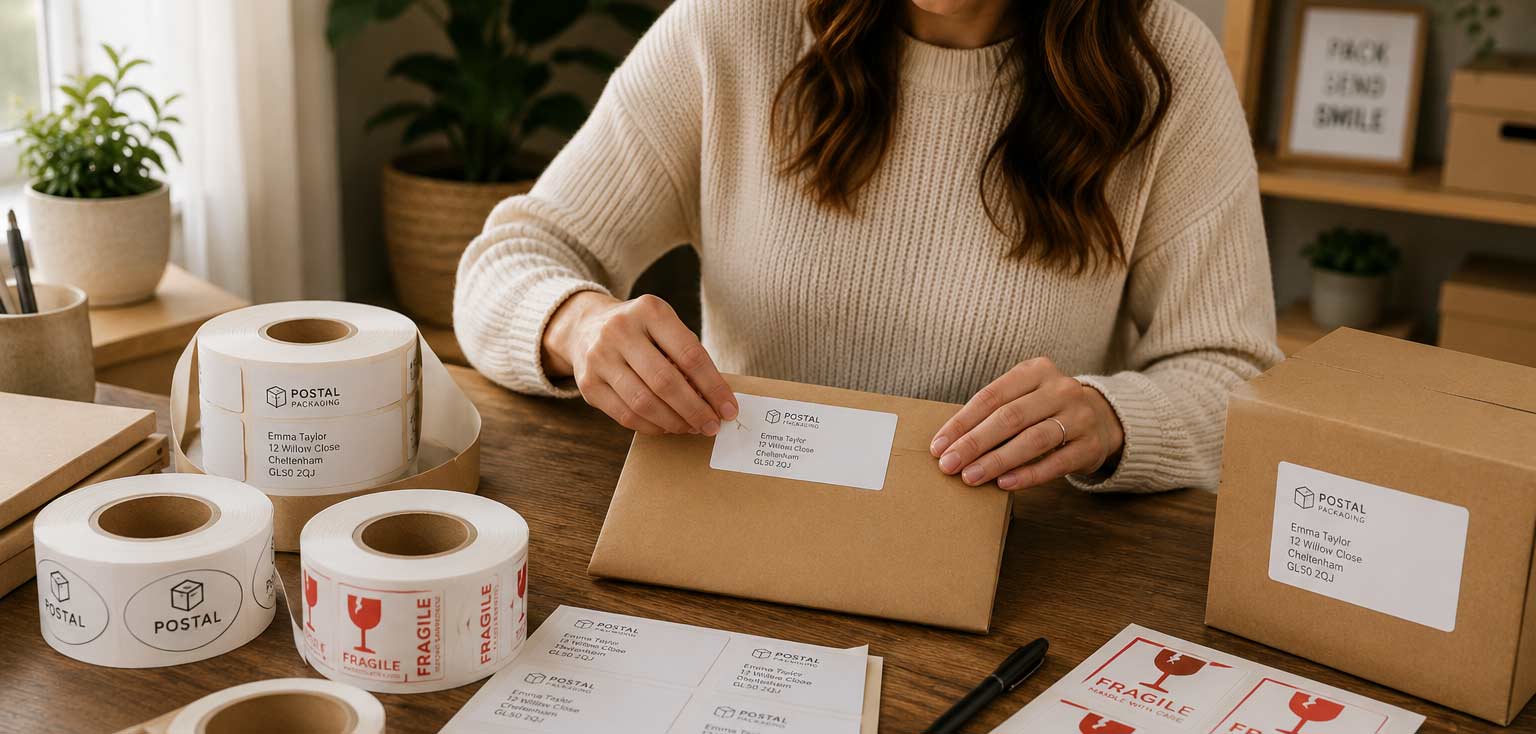
Address labels: The most widely used format. Standard sizes are 99.1 x 67.7mm (8 per A4 sheet) and 63.5 x 38.1mm (21 per A4 sheet). Compatible with laser, inkjet and thermal printers.
Fragile labels: Handling instruction labels applied to the exterior of parcels containing breakable goods. Signal to carriers that contents require care.
Return address labels: Required by Royal Mail on all parcels. If undeliverable, the parcel is returned to the sender address shown.
Thermal labels: Used with dedicated thermal label printers, avoiding ink cost and producing durable, smudge-resistant labels. The recommended format for reliable barcode scanning in high-volume e-commerce operations.
Labels


Envelope Closure Types
The closure type affects sealing speed, security and compatibility with franking machines and insertion equipment. Choosing the right closure reduces labour cost in high-volume operations and ensures compatibility with your mailing setup.
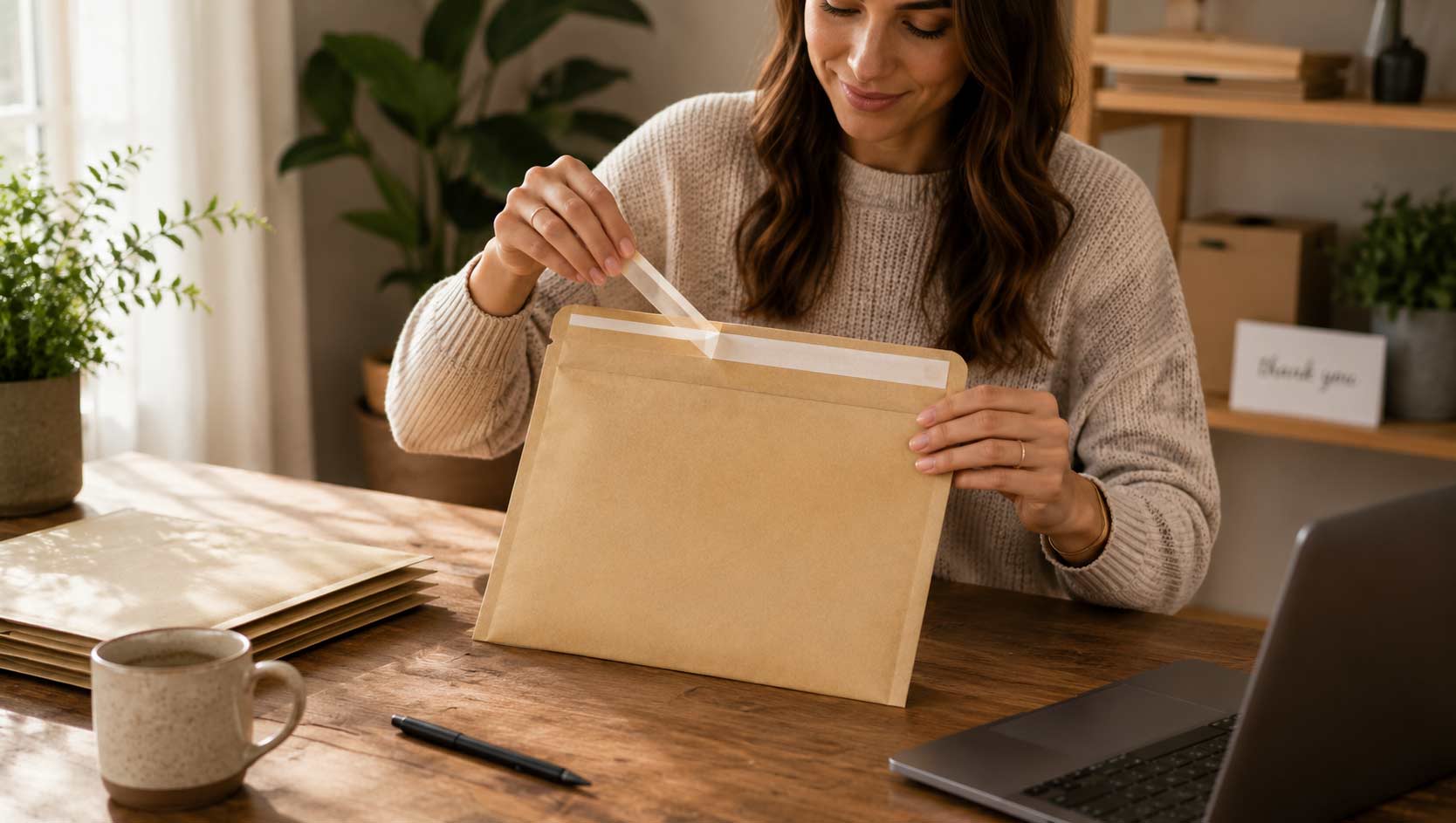
Peel and Seal
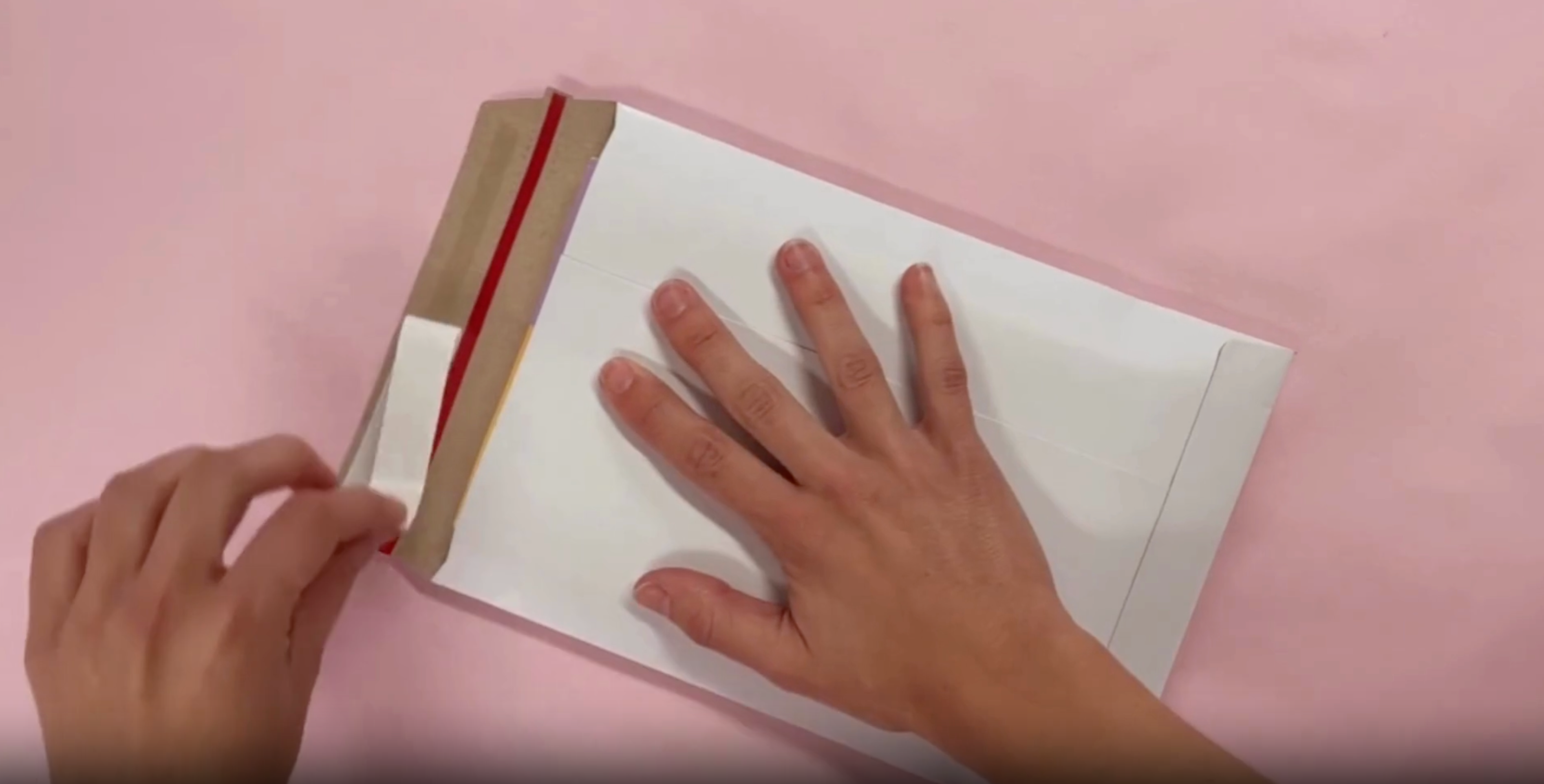
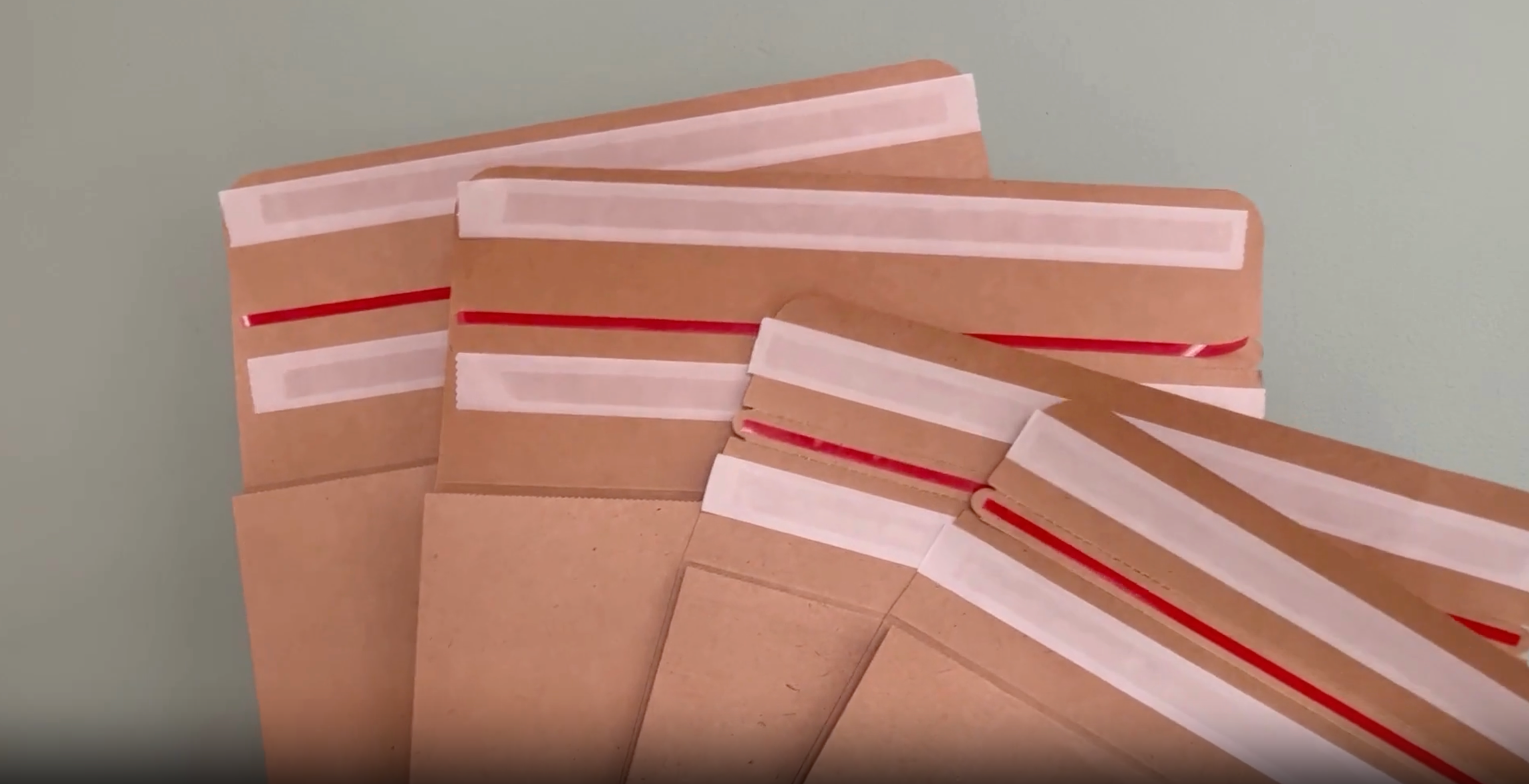
A protective strip covers a strong adhesive band. Peel the strip away and press the flap to seal with no moisture required. The most widely used closure for business and e-commerce mailing because it is fast, reliable and leaves a clean, professional exterior. Available across every envelope format and size, from DL business envelopes through to C4 and coloured variants.
Peel and Seal Envelopes


Other Closure Types
Gummed
Gummed
The traditional moisture-activated closure. The adhesive on the flap is activated with moisture, by licking, a damp sponge or an automatic envelope moistener, then pressed to seal. Gummed envelopes are the required closure type for most franking machines and automated insertion equipment, making them the standard for high-volume business mailing operations. Typically the most cost-effective closure at volume. Shop gummed envelopes
Self Seal
Self Seal
Pre-applied pressure-sensitive adhesive on both the flap and the envelope body. Fold the flap down and press firmly to seal. No strip to peel,, no moisture needed. Self-seal is the fastest-to-close format, making it well-suited to high-volume packing environments where every second counts. The bond is permanent and tamper-evident once sealed. Shop self-seal envelopes
String and Washer
String and Washer
A circular washer on the flap with a length of string that winds around a second washer to close. The defining feature is that string and washer envelopes can be opened and resealed indefinitely and are the standard for inter-office document circulation, archival filing and any use case where permanent sealing is not required. Shop string and washer envelopes
Grip Seal
Grip Seal
A zip-lock style press-together closure that creates a secure, tamper-evident seal. Grip seal envelopes are reusable and particularly suited to packaging small items, documents and promotional materials where security and easy re-opening are both priorities.
Frequently Asked Questions
Should I Look At Internal Or External Dimensions When Buying Boxes Or Bubble Bags?
Should I Look At Internal Or External Dimensions When Buying Boxes Or Bubble Bags?
Always look at the internal dimensions. Cardboard walls add thickness (typically 3mm for single wall, 6mm for double wall), and bubble wrap lining takes up physical space inside the bag — meaning the external size of the package can be noticeably larger than what actually fits inside. If you are shipping to a specific Royal Mail size band such as Large Letter (max 353 x 250 x 25mm) or Small Parcel (max 450 x 350 x 160mm), work backwards from the maximum external dimensions and account for wall thickness to ensure your packed item qualifies at the right postage rate.
What Are B-Series Envelope Sizes And When Would I Use Them?
What Are B-Series Envelope Sizes And When Would I Use Them?
The B series follows the same mathematical structure as the C series, running from B0 down to B10. Each B size sits geometrically halfway between the same-numbered A size and the next size up — so a B4 envelope, for example, falls precisely between A4 and A3. This gives B-series envelopes a little extra breathing room over their C-series equivalents, making them useful when contents are slightly too large for a standard C envelope or need a looser fit.
B4 (250 x 353mm) — Thick A4 document stacks, heavy catalogues, and small A4 booklets.
B5 (176 x 250mm) — Thick A5 booklets, magazines, and standard tablet-sized items.
B6 (125 x 176mm) — Embellished greeting cards, invitations, and passports.
B7 (88 x 125mm) — Passports, index cards, and larger gift tags.
What Do The Letter And Number Codes On Bubble Bags Mean?
What Do The Letter And Number Codes On Bubble Bags Mean?
Most bubble bag manufacturers use a standard letter or number coding system that maps directly to paper sizes, so you can quickly identify what will fit inside. The codes run from A (or 000) at the smallest up to K (or 7) for the largest formats.
A / 000 (110 x 160mm) — Jewellery, keys, USB drives, and business cards.
B / 00 (120 x 210mm) — Small electronics, cosmetics, and cassette tapes.
C / 0 (150 x 215mm) — A6 documents, small paperbacks, and CDs.
D / 1 (180 x 265mm) — A5 booklets, DVDs, and video games.
E / 2 (220 x 265mm) — Small tablets and slightly wider A5 items.
F / 3 (220 x 330mm) — A4 documents (snug fit) and regular clothing.
G / 4 (240 x 330mm) — A4 documents and magazines with room to spare.
H / 5 (270 x 360mm) — Small clothing items and larger books.
J / 6 (300 x 445mm) — A3 folded in half, shoes, and multi-item orders.
K / 7 (350 x 470mm) — Bulky clothing, coats, and small pillows.
Browse our full range of bubble bag mailers to find the right size for your dispatch requirements.
What's The Difference Between E Flute and F Flute?
What's The Difference Between E Flute and F Flute?
Both are lightweight corrugated board used in retail and e-commerce packaging, but they differ in thickness. E flute is approximately 1.6mm thick and offers slightly more cushioning, making it a good choice for fragile or heavier items. F flute is thinner at around 0.8mm, which means it takes up less space, costs less to ship, and provides a better surface for printing. F flute is generally preferred where presentation matters and the contents don't require heavy protection.
What's The Smallest and Largest Envelope You Stock?
What's The Smallest and Largest Envelope You Stock?
Our smallest standard envelope is C7 (82 x 113mm), ideal for gift cards, vouchers, and small enclosures. We also stock a range of small envelopes in formats smaller than C7 for specialist uses. At the other end of the range, our C3 envelopes (324 x 450mm) hold A3 documents flat. If you need extra depth for bulkier contents, our gusset expansion envelopes are available up to 457 x 324mm with an expanding base to accommodate thicker document packs.
What Envelope Size Fits An A4 Sheet?
What Envelope Size Fits An A4 Sheet?
Three envelopes fit A4 paper depending on how you fold it: a DL envelope (110 x 220mm) fits A4 folded in thirds, a C5 envelope (162 x 229mm) fits A4 folded in half, and a C4 envelope (229 x 324mm) fits A4 completely flat without any folding. For documents that absolutely cannot be folded, including contracts, certificates and presentations, so C4 is the correct choice.
What Does DL Stand For In Envelopes?
What Does DL Stand For In Envelopes?
DL stands for Dimension Lengthwise and measures 110 x 220mm, sized specifically to hold an A4 sheet folded into three equal sections. It is the most widely used business envelope format in the UK, standard for invoices, letters, statements and marketing inserts. DL envelopes qualify for Royal Mail standard letter postage (2nd class from 91p) provided the packed weight stays under 100g.
What Does The C Mean In Envelope Sizes Like C4, C5 And C6?
What Does The C Mean In Envelope Sizes Like C4, C5 And C6?
The C in envelope sizing refers to the ISO C paper series. Each C size is calculated as the geometric mean of the corresponding A and B sizes, which means every C envelope is sized to hold the equivalent A-series paper flat. A C6 envelope (114 x 162mm) holds A6 paper, a C5 envelope (162 x 229mm) holds A5, and a C4 envelope (229 x 324mm) holds A4. The system runs from C0 (917 x 1297mm) down to C10 (28 x 40mm), though C3 through C7 cover the vast majority of everyday mailing needs.
What Size Envelope Is Used For Greeting Cards?
What Size Envelope Is Used For Greeting Cards?
The standard greeting card envelope is C6 (114 x 162mm), which fits A6 cards flat or A4 cards folded into quarters. For larger cards, C5 (162 x 229mm) fits A5 cards flat. Square cards use square envelopes, typically 165 x 165mm or 220 x 220mm. Both C6 and C5 qualify for Royal Mail standard letter postage, making them cost-effective for card mailings at volume.
What Is The Difference Between C4 And C5 Envelopes?
What Is The Difference Between C4 And C5 Envelopes?
A C5 envelope (162 x 229mm) holds A5 documents flat or A4 folded once. A C4 envelope (229 x 324mm) holds a full A4 sheet completely flat with no folding required. C4 is the right choice when the document absolutely cannot be folded, including contracts, certificates, presentations and legal documents. C5 is more compact and suits multi-page documents, brochures and A4 letters that can tolerate a single fold. Both qualify for Royal Mail large letter postage.
What Is The Difference Between Peel And Seal And Self-Seal Envelopes?
What Is The Difference Between Peel And Seal And Self-Seal Envelopes?
Peel and seal envelopes have a protective strip covering the adhesive. Peel the strip away then press the flap to close. Self-seal envelopes have adhesive pre-applied to both surfaces, fold and press directly with no strip to remove. Both are moisture-free and create a permanent bond. Self-seal is marginally faster for high-volume packing but peel and seal is more widely available across different formats and sizes. Neither is compatible with franking machines, so gummed envelopes are required for franking.
Are Gummed Envelopes Compatible With Franking Machines?
Are Gummed Envelopes Compatible With Franking Machines?
Yes. Gummed envelopes are the required closure type for most franking machines and automated insertion equipment. The moisture-activated adhesive on a gummed flap is compatible with the moistening rollers in standard franking machines, whereas peel and seal and self-seal envelopes are not. If your operation uses a franking machine, always specify gummed when ordering. Browse gummed envelopes in DL, C5 and C4 formats.
What Size Label Do I Need For A Parcel?
What Size Label Do I Need For A Parcel?
The most common parcel label sizes are 99.1 x 67.7mm (8 per A4 sheet) and 99.1 x 57mm (10 per A4 sheet). For thermal label printers the standard is 100 x 150mm. The label must be large enough to show the full delivery address, postcode, barcode and return address clearly without crowding. Thermal-printed labels are recommended for high-volume e-commerce operations as they are smudge-resistant and produce reliable barcodes. Browse our full range of labels for all printer types and sizes.
What Is The Difference Between Single Wall And Double Wall Cardboard Boxes?
What Is The Difference Between Single Wall And Double Wall Cardboard Boxes?
Single wall boxes have one layer of corrugated fluting sandwiched between two flat sheets of card, suitable for most standard e-commerce dispatch up to moderate weights. Double wall boxes have two layers of corrugated fluting, providing significantly greater crush resistance and rigidity. Double wall is recommended for heavy goods, fragile items and products that will be stacked in storage. For most everyday dispatch, single wall cardboard boxes are sufficient and more cost-effective.
What Size Mailing Bag Do I Need?
What Size Mailing Bag Do I Need?
Mailing bag sizes are typically labelled by their internal dimensions. As a guide: small bags (around 170 x 230mm) suit jewellery, accessories and small folded garments; medium bags (around 250 x 350mm) suit T-shirts, small clothing items and flat accessories; large bags (around 350 x 500mm) suit folded jumpers, jeans and multi-item clothing orders. Always measure your product flat and allow at least 20mm on each side for a comfortable fit without overfilling. Browse our full mailing bag range by size.
What Packaging Qualifies As A Royal Mail Large Letter?
What Packaging Qualifies As A Royal Mail Large Letter?
Any item up to 353 x 250mm, 25mm thick and 750g qualifies for Royal Mail large letter postage, which is a significantly lower rate than small parcel. This covers C4 envelopes, large letter size envelopes and large letter postal boxes (rigid items up to 25mm depth). Staying within large letter limits is one of the most reliable ways to reduce postage cost on flat or thin items. See the full Royal Mail postage rates guide for current prices.
Are Mailing Bags Or Cardboard Boxes Better For E-Commerce?
Are Mailing Bags Or Cardboard Boxes Better For E-Commerce?
It depends on the product. Mailing bags are lighter, which keeps postage costs lower and they suit clothing, accessories and soft goods that are not fragile. Cardboard boxes provide rigid protection and are better for fragile items, structured products and anything that could be damaged by compression in transit. For fragile items where you still want a lightweight format, bubble bag mailers provide cushioning without the full weight of a box. The smallest box or bag that fits the product safely is almost always the most cost-effective choice.
What Are The Current Royal Mail Postage Rates?
What Are The Current Royal Mail Postage Rates?
Standard Letter 2nd class from 91p, Large Letter 2nd class from £1.55, Small Parcel Tracked 48 from £5.65, Medium Parcel Tracked 48 from £5.65 up to 2kg. See the complete Royal Mail postage rates guide for current 1st class, 2nd class, Tracked 24 and Tracked 48 prices across all formats, correct as of April 2026.
What Our Customers Say
See why we’re trusted as by thousands of UK businesses for packaging and envelopes through our customer reviews.

Envelope Printing Customer

Envelope Customer

First Time Customer

Wholesale+ Member

Envelope Printing Customer

Wholesale+ Member

Sample Customer

Packaging Customer
Useful support for flat pack cartons
